


Story by Tim Wenger
Illustration by Maggie Johnson
The Denver we know today was vastly different in the 1980s. Then, our aging airport primarily served business travelers and those flying in only to immediately depart the city in favor of the high country. We were the cow town of the high plains, and while that gritty genus instilled a sense of stubborn pride, deep down what the city really wanted was some damn glory.
We needed a Super Bowl. And a real baseball team. Maybe even a famous restaurant that channeled vibes beyond those of a John Wayne movie. More than anything, Denver wanted to be a big league town. The road to get there was long and paved with the grease stains of Rocky Mountain oysters (if you need to look it up, you haven’t yet fully explored Denver’s food scene).
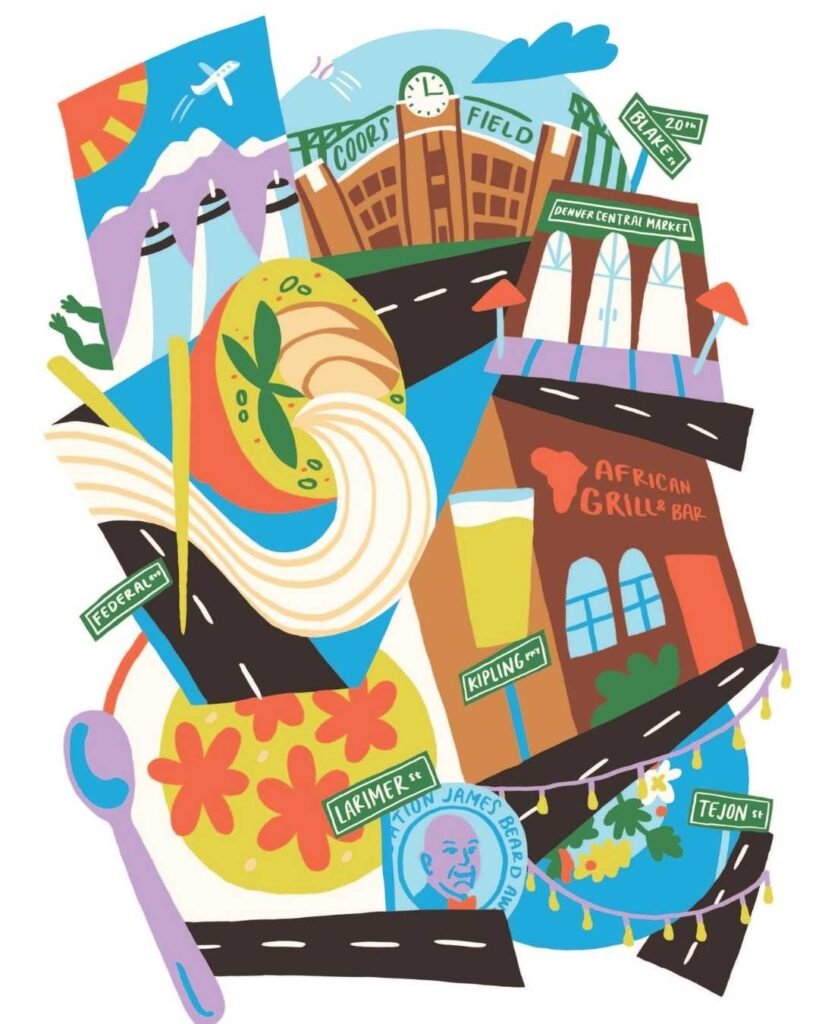
Nearly $5 billion went into building a world-class airport in the boonies; taxpayers poured another $200 million into an elite downtown ballpark. That ballpark, in particular, certified Denver’s big-league chops beyond the diamond itself. Tens of thousands of fans in the area, 81 nights a year, quickly drew development in the form of restaurants, pubs, and apartments. From 1995, the growth that sprouted from 20th and Blake and beyond into what’s now known as downtown Denver and the trendy Lower Downtown (LoDo), River North (RiNo), and Ballpark districts — effectively kickstarted the Denver dining and drinking scene we know today.
Even as the sprawl of Denver’s metroplex further swallows the memory of the Valley Highway, some of the city’s best food — from the Neapolitan-certified pies at Marco’s Coal-Fired to the globe-spanning dishes coming out of the Denver Central Market — is served in a part of town that drew few glances prior to the opening of Coors Field.
I was born in Denver in 1983 and have spent most of my life here. I’ve moved in and out a few times but have always spent ample time dining out in the city, even as a visitor. It was in 2009 when I first recognized a level-up in what I was tasting. In the summer of that year a friend took a job at a pho place on 38th Avenue and promptly invited a few of us in for lunch. I’d never heard of pho, had never even thought of trying Vietnamese food. I was hooked from that first bowl of pho ga.
Shortly thereafter, I launched a now-long-defunct blog chronicling the growing number of noodle haunts along Federal Boulevard and became a regular at Pho on 6th, where the grilled chicken came on the side, basted in a tangy garlic sauce. I couldn’t get enough.
This, of course, led to an impulse to try more, to diversify. Frog legs at the Asian Cajun became a favorite. I rented a tiny basement apartment in Wash Park West for a few years in my 20s, and walking the few blocks to Blue Bonnet became a pastime. The mie goreng at Jaya on Colorado Boulevard still reminds me of the summer I spent in Bali. My favorite spot in the city, though, one that I’ll return to as long as they’re open, is African Grill & Bar. Originally located in Green Valley Ranch and now on Kipling in Lakewood, Theodora and Sylvester Osei-Fordwuo hooked me on jollof rice and Red Red from my first visit. Once, my dish was so spicy that I spent 10 minutes in the washroom barely keeping my face on my head — the result of visiting with my returned-Peace-Corps-volunteer wife, Alisha, who had served in Togo and requested that our food not be “cheapened to meet the western palate.” I survived, and we still visit regularly. Theodora still comes out from the kitchen to hug us upon arrival each time.
Dining here is all the proof I could ask for that this city has reached the global stage.
I feel fortunate to have experienced my hometown’s evolution from within and from afar. Its growth has properly aligned with the city’s progressive immigration policies: By 2000, Denver had tripled its foreign-born population to 8.6 percent. An influx of respected chefs opened innovative restaurants like Frank Bonanno’s game-changing Mizuna in 2001, transforming Denver from a steak-and-potatoes town into a dynamic, chef-driven hub. The corresponding craft beer boom certainly helped smooth any rough edges.
In 2013, the tide turned firmly in Denver’s favor. That year Chef Jennifer Jasinski of Rioja was named Best Chef Southwest, marking the first time a Denver chef had taken a major James Beard Foundation Award. Star Kitchen’s dim sum had by then woven its way into the cross-cultural fabric of Federal. The good vibes were palpable, though there have been sad moments — the 2022 closing of the Saucy Noodle hit hard, as it was one of the first places I took my now-wife when we began dating.
Still, the world knows now that Denver has chops. When Michelin finally landed in the city a few years ago, Beckon, Brutø, and The Wolf’s Tailor were ready to rock. Across the city, a great meal alongside a fresh beer brewed up the road (or on-site) is now the norm rather than the exception. Wherever I travel, I’m proud to be from Denver, and from Colorado more broadly.
This is our taste of the big leagues, folks — and just like “Elway’s Helicopter Dive,” an iconic 3rd-and-6 quarterback scramble (or rather, headfirst dive and aerial spin, upon collision with Packers defenders, which thrust momentum in Denver’s favor to give this historic team their first championship win) — or a classic fresh-powder day in the Rockies, it feels oh-so-good to be a Denverite.